
Guardsman Air Duct Cleaning in Provo: A Homeowner’s Guide
If you’re looking up Guardsman air duct cleaning in Provo, you probably have a document in your hand – a quote, a warranty benefit summary, or an invoice from work already done – and you’re trying to work out what you actually bought. That’s a fair question, and most homeowners never get a straight answer to it. This guide gives you a technical framework to read the scope of work, judge the equipment behind it, and verify the job whether it happened last week or last year. If you’d rather have someone walk through your system with you, call (866) 937-8191. We answer 24/7. Fast dispatch from 7am to 7pm, Sunday through Friday.
What does “Guardsman air duct cleaning” actually mean in Provo?
Guardsman is a product line used in duct sanitizing and protection, not a cleaning method and not a certification. When a Provo homeowner sees “Guardsman treatment” on a quote, it usually refers to an application made after the ducts are cleaned – a coating or sanitizing product applied to interior surfaces. The cleaning itself is a separate step, and it’s the step that matters most.
That distinction is where confusion starts. A quote can advertise Guardsman-grade treatment and still describe a very light cleaning underneath it. Applying a product to ducts that weren’t properly cleaned is like mopping a floor before you sweep it. The liquid goes on, the debris stays.
Here’s how to separate the two parts on any document you’re reading:
- Cleaning scope: which components were cleaned – supply trunks, branch runs, return ducts, register boots, the air handler, the blower wheel, the drain pan.
- Equipment: the vacuum type and its rated airflow, plus the agitation tool used to loosen debris from duct walls.
- Treatment: what product was applied, and whether it was applied after cleaning and drying, not during.
- Standard: which industry standard the work was performed to, and what documentation you receive afterward.
In our experience around Provo, the treatment line is usually the one that’s spelled out clearly. The cleaning scope is the line that’s vague. That tells you where to push.
How do you read the scope of work on a duct cleaning quote?
A legitimate full-system scope in Provo names the components, the equipment, and the standard – and it’s specific enough that two contractors couldn’t submit the same wording for different jobs. If the scope is one sentence long, it’s not a scope.
Walk through the document and check for these three things:
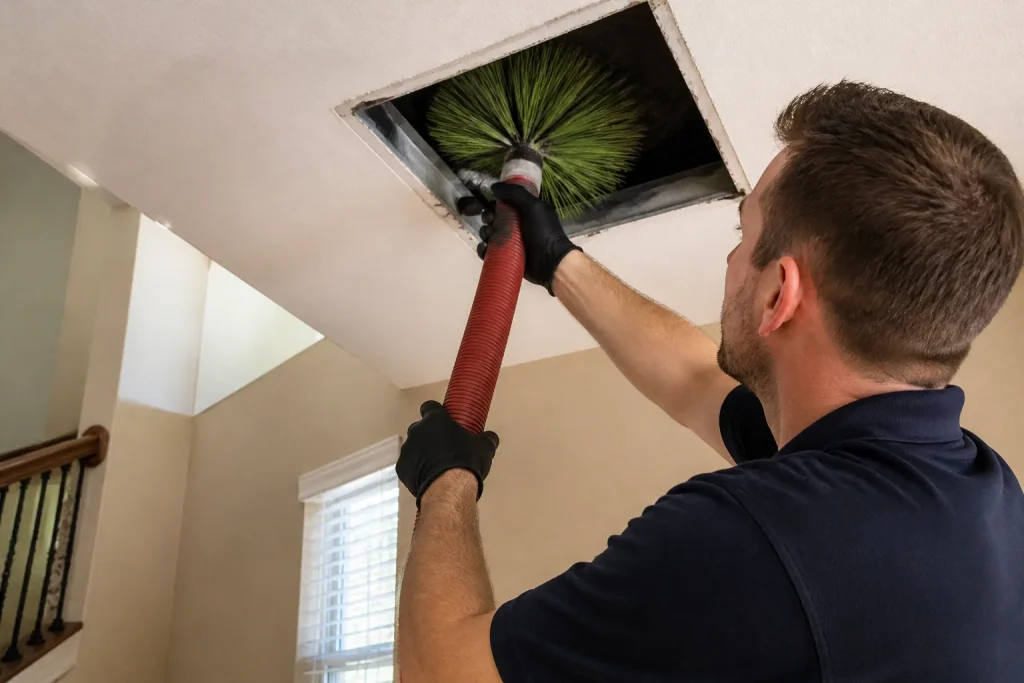
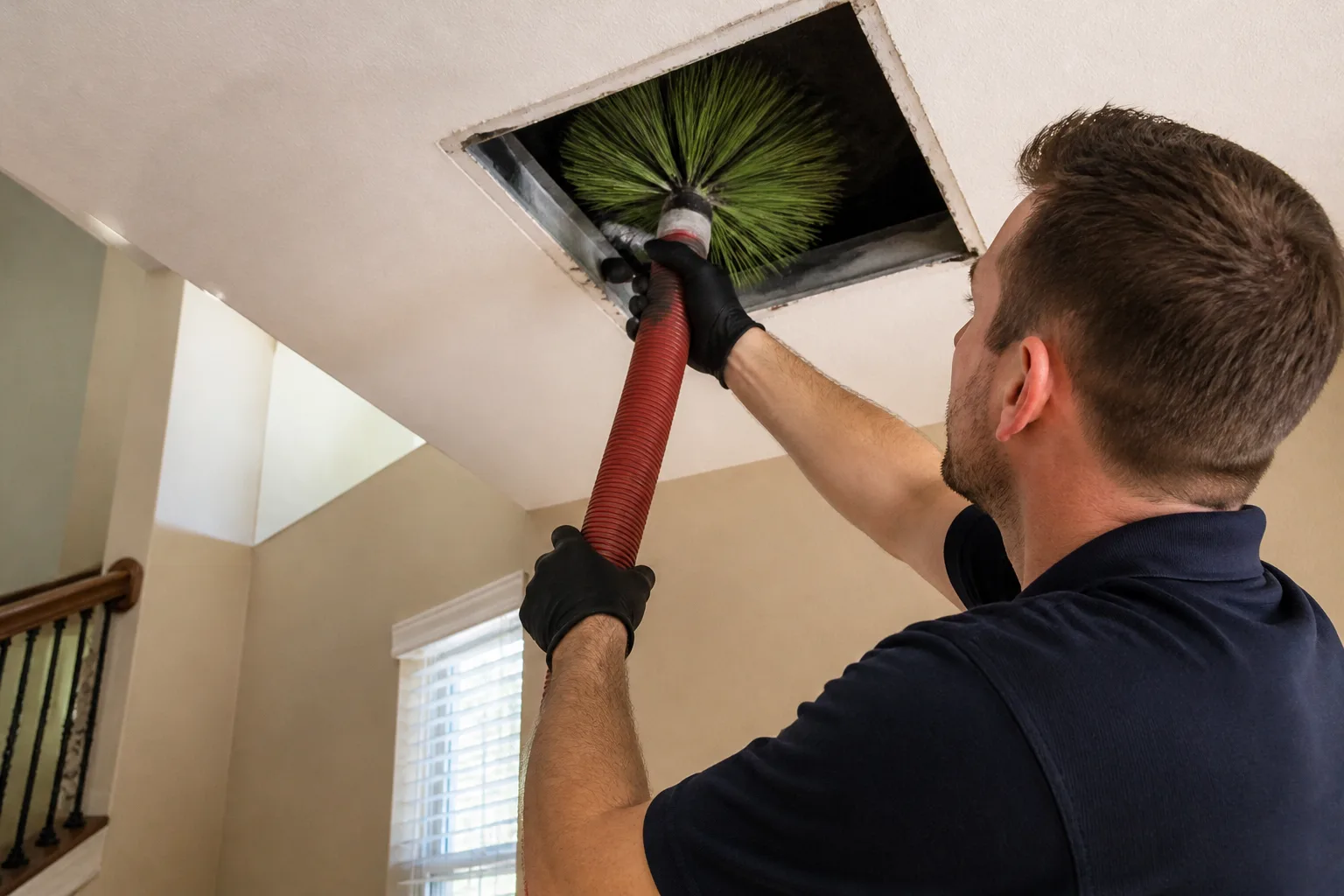
- Equipment, named. Look for a source-removal vacuum with a stated airflow rating and a contact-cleaning tool that reaches the duct walls. Rotobrush contact-cleaning systems and Nikro HEPA extraction units are the equipment names you’ll see on professional scopes, and they show up because they’re what commercial and restoration contractors use. A shop vacuum and a hose is not the same category of tool, and a scope that doesn’t name its equipment usually has a reason.
- Components, listed. “Ducts cleaned” covers almost nothing. You want supply and return runs, boots, the air handler cabinet, the blower wheel, and the drain pan addressed in writing.
- Standard, cited. NADCA’s ACR standard (Assessment, Cleaning and Restoration of HVAC systems) is the reference point for how the work should be assessed, contained, cleaned, and verified. A scope that meets ACR will describe containment and post-cleaning verification. A scope built around a lighter proprietary standard tends to skip both.
Containment is the quiet tell. On any job where debris is being loosened, negative-air filtration equipment – we use Abatement Technologies units on every job – captures particles at the source instead of pushing them into the room. If a Provo quote doesn’t mention containment, ask about it directly.
How do you verify a duct cleaning was actually done in Provo?
You verify it with your own eyes and your own airflow, at three points: the registers, the boots behind the vent covers, and the air handler. You don’t need equipment for the first two, and most homeowners can check the third if their system layout allows it.
Run these checks after any cleaning, regardless of who performed it:
- Register airflow. Hold a tissue or your hand at each supply register. Flow should feel even across rooms. A register that’s weaker than before cleaning is worth flagging.
- Boot and register covers. Pop off a vent cover and look at the sheet-metal boot and the first few inches of duct. You’re looking for loose dust sitting on surfaces. A clean boot isn’t shiny – it’s free of the gritty film that builds up over years.
- The air handler. If you can safely open the service panel (power off at the breaker first, and only if your panel is designed for homeowner access), look at the blower wheel and the drain pan. The blower wheel should be free of the caked dust that throws it out of balance. The drain pan should be clear, not holding standing water or sludge.
- Before-and-after photos. A contractor using real contact-cleaning and HEPA extraction has photos of the inside of your ducts to show you. Ask for them. Photos of the register covers alone prove nothing.
One practical note for Provo homes with older forced-air systems: if the return duct run is long and the registers are original, a light dust film can return within weeks from normal household activity. That’s not a failed cleaning. Heavy buildup in the boots right after the job is.
Bundled warranty duct cleaning vs. a dedicated full-system cleaning
A home warranty or service plan that includes duct cleaning as a benefit is not the same thing as a dedicated full-system cleaning, and the difference shows up in equipment and dwell time. Bundled benefits are usually priced to fit inside a plan, which means lighter equipment and a shorter pass through the system.
That’s not a scam. It’s a different product. But if you’re in Provo and you bought a plan expecting full contact cleaning of every run, it’s worth knowing what you signed up for:
- Equipment. Bundled services often use portable vacuums with lower airflow and no wall-contact agitation tool. That removes loose surface dust and leaves the adhered layer on the duct walls.
- Dwell time. A full-system cleaning takes real time per run, and time is what a bundled benefit usually trims first.
- Containment. Negative-air filtration is an added setup step. Some bundled scopes skip it entirely, which is fine for light dust and not fine for a system with renovation debris, pet hair, or years of accumulation.
- Components. The air handler and blower wheel are often outside the bundled scope.
If you have allergies, pets, a recent remodel, or an aging HVAC system in your Provo home, a dedicated air duct cleaning is the version that actually moves the needle. For a system where the dryer line is also overdue, a separate dryer vent cleaning addresses a fire-safety issue that duct cleaning never touches.
What does follow-up service look like if a previous cleaning was incomplete?
Follow-up service means a fresh assessment first, then a scope built around what’s actually still in the system – not a repeat of the original package. A reputable Provo contractor will look before quoting, and will tell you plainly if the earlier work was adequate.
A reasonable sequence looks like this:
- Assess. Camera inspection or physical inspection at the boots, plenum, and air handler to see what remains and where it is.
- Document. Note the condition in writing before work begins, so you have a baseline.
- Clean to ACR scope. Contact cleaning on every accessible run, source-removal vacuum, containment with negative-air filtration throughout.
- Repair and seal if needed. Leaky duct joints undercut a cleaning’s value – air quality and efficiency both suffer when a Provo system pulls attic or crawlspace air through gaps. Sealing closes that loop, and so does a full HVAC cleaning that reaches the coil, blower, and drain pan.
- Verify. Post-cleaning photos and a walkthrough with you.
A re-clean doesn’t void a prior service record. It just means someone assessed the system and cleaned to a stated standard, which is exactly what should have happened the first time.
When to call a pro – and what to ask before you book in Provo
Call a professional when you can see debris in the boots, when airflow drops room to room, after a renovation, or when anyone in the household reacts to the air. Duct interiors are an enclosed system with sharp metal edges and a blower that can spin on residual power. This isn’t a homeowner job, and we’d rather you didn’t try.
Ask these questions of any provider, including a warranty program:
- What vacuum and airflow rating will you use, and what contact-cleaning tool?
- Which components are in scope, and is the air handler included?
- Will you use negative-air containment during the job?
- Is the work performed to NADCA ACR standards? Ask them to say it out loud.
- Do I get post-cleaning photos and a written summary?
If the answers are vague, that’s your answer. Our technicians have up to 10 years of experience reading exactly these documents, and we’re happy to look at yours. For a whole-picture review of your system, start with Provo Air Duct Cleaning Pros – we service the full pathway from air handler to vent cover.
The Bottom Line
Guardsman products are a treatment layer, not proof of cleaning. What proves cleaning is the equipment named on the scope (Rotobrush contact-cleaning and Nikro HEPA extraction, not a shop vacuum), the components listed (including the air handler and blower), the standard cited (NADCA ACR), and the documentation you receive afterward. You can verify the job yourself at the registers, the boots, and the air handler. And if an earlier job fell short, a fresh assessment is a reasonable next step in Provo – not a wasted expense.
If you’re in Provo and need help, Provo Air Duct Cleaning Pros offers free estimates – call (866) 937-8191. We answer 24/7. Fast dispatch from 7am to 7pm, Sunday through Friday.
Frequently Asked Questions
No. Guardsman products are sanitizing and protective treatments applied to duct interiors after cleaning, not a cleaning method. The cleaning itself is the mechanical removal of debris from duct walls and components using contact agitation and a source-removal vacuum. A quote that features the treatment but stays vague on cleaning scope deserves a second question.
Check three places: airflow at the supply registers, the sheet-metal boots behind the vent covers, and the air handler’s blower wheel and drain pan if you can access them safely with power off. Even, consistent airflow, clean boots, and a blower free of caked dust are the signs. Before-and-after photos from inside the ducts confirm it. Call (866) 937-8191 if you’d like help reading what you’ve got – estimates are free.
Often it doesn’t, and that’s a product-design issue rather than a scam. Bundled benefits typically use lighter equipment and shorter dwell time than a full-system cleaning performed to NADCA’s ACR standard. Ask whether the provider follows ACR, and ask which equipment they’ll bring. If you want a full-system scope, call (866) 937-8191 for a straight answer.
No. A follow-up cleaning is simply a new assessment and a new scope. A contractor should inspect first, document the current condition, then clean to the standard – that record stands on its own.
Written by the team at Provo Air Duct Cleaning Pros.
Need Air Duct Cleaning Help?
Call Provo Air Duct Cleaning Pros - the local pro we connect you with is licensed and insured, here with fast help in Provo.
(866) 937-8191